Understanding Audism in Deaf Sport

The unseen barrier that perpetuates the discrimination of deaf people in sport.

Audism is the belief that hearing and speaking are superior to being deaf and using sign language. It leads to discrimination and systemic barriers that marginalize deaf people in education, employment, and sport. The term was coined by Tom Humphries (1977) and has since been explored in Deaf Studies and Disability Studies.

In sport, audism manifests in coaching structures, team dynamics, funding, communication, and access to opportunities. Many sporting organizations fail to recognize Deaf sport as distinct from disability sport or do not provide adequate accommodations, which limits deaf athletes’ participation and success.

Prof Tom Humphries first coined the phrase Audism in the 1970s

Key Aspects of Audism in Deaf Sport:

Linguistic Discrimination – Favouring spoken language over sign language

  • For many coaches and team staff verbal communication is the default, leaving deaf athletes struggling to follow instructions in training and competition. The also take the path of least resistance and engage more with non-signers.
  • Most organisations in the sports economy fail to provide sign language interpreters, assuming that lip-reading or written communication is enough—despite evidence that lip-reading is only about 30-40% effective.
  • Deaf sports teams and events often receive less media coverage because they do not fit traditional (spoken language-based) broadcasting formats.

Medical Model Bias – Viewing deafness as a “deficiency” that needs fixing

  • Sports federations inadvertently, out of ignorance, prioritize hearing aids or cochlear implants over sign language and accessible communication strategies, pushing deaf athletes toward a “hearing” approach to sport.
  • Deaf athletes who do not use hearing technology are overlooked or excluded because coaches and administrators see them as “too difficult to work with.”
  • In classification systems for disability sports, such as the European Disability Golf Association, deaf athletes are disallowed from competing in their elite class compete because deafness alone does not qualify them for Paralympic categories, reinforcing the idea that the lived-experience of deaf athletes and the Deaflympic classification is less valid.

Institutional Barriers – Lack of access to coaching, funding, and competition pathways

  • Many national governing bodies do not fund elite Deaf sport at the same level as other disability sports, making it harder for deaf athletes to access high-performance training.
  • Deaf athletes often face fewer opportunities to compete internationally because Deaf-specific events (like the Deaflympics) receive far less support compared to the Paralympics or mainstream sport.
  • In some cases, deaf players in mainstream teams are expected to “adapt” rather than teams making accommodations for them. For example, if a referee relies only on a whistle, a deaf athlete misses key signals during a match.

Cultural Erasure – Disregarding Deaf sport as a distinct culture

  • Deaf sport has its own history, traditions, and rules, yet many sports organizations treat Deaf sport as an afterthought, assuming deaf athletes should just integrate into mainstream teams.
  • Sporting federations sometimes fail to recognize Deaf sport records and achievements, treating them as secondary to hearing competitions.
  • Deaf athletes feel pressured to conform to hearing norms rather than being encouraged to celebrate Deaf identity in sport.
  • Sports federations (Cricket Australia) initially adopting deaf sports teams but over time failing to recognise the strategic significance of their Deaf sport partners (Deaf Cricket Australia) and capitalising on Deaf Gain.

Everyday Prejudice – Patronizing attitudes and lack of inclusion in team culture

  • Deaf athletes in mixed (hearing and deaf) teams often experience exclusion—for example, being left out of informal team chats or not being fully involved in pre-game strategy discussions.
  • Hearing coaches and teammates sometimes assume deaf athletes need “extra help”, even when they are fully capable of competing at the same level.
  • There have been reports of derogatory remarks made against deaf players in mixed disability teams, reinforcing the idea that they are not fully accepted.
Illustration from “What is Audism and How to Avoid It”

Audism in sport is not just about access—it’s about respect, equity, and recognition. True inclusion means more than adding an interpreter or letting a deaf player join a hearing team—it requires systemic changes in funding, training, and competition structures. Recognizing Deaf sport as a distinct and equal sporting category is crucial for breaking down audism and allowing deaf athletes to compete and thrive on their own terms.

To read more on the politics and challenges for Deaf sport “Same Spirit Different Team”

Breaking Barriers or Building Them? The Case for Deaf Women’s Cricket

A report by UK Deaf Sport and Women in Sport sheds light on the significant challenges faced by deaf teenage girls in sport. It identifies key barriers such as communication difficulties, lack of inclusive environments, and gender bias that discourage participation. These findings are not unique to the UK—globally, deaf women and girls face systemic obstacles when trying to engage in sport at all levels.

A striking example of this is Cricket Australia’s decision not to support Deaf Cricket Australia women’s team. This choice sends a disappointing message about the priorities within the sport and the level of commitment to true inclusivity. Deaf women and girls in Australia, much like their counterparts in the UK, are being told—explicitly or implicitly—that their participation is not a priority.

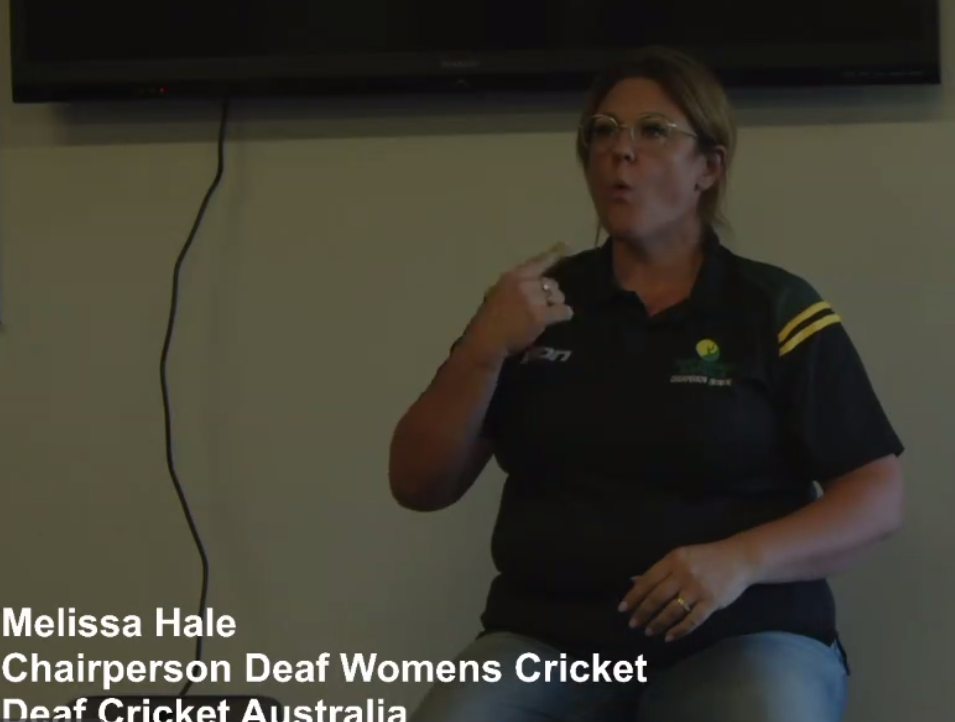
Melissa Hale, Deaf Cricket Australia Read Bianna Boeker’s interview

The Parallels Between UK and Australian Deaf Women’s Sport

The UK Deaf Sport report highlights the importance of role models, accessible pathways, and a welcoming environment in fostering participation. When governing bodies fail to invest in women’s deaf sport, they reinforce the very barriers that studies like this seek to dismantle. If deaf teenage girls already struggle with access to inclusive environments, how much harder is it when there are no representative teams at a national level?

The impact of this decision extends beyond the cricket field. Sport is a crucial vehicle for confidence, leadership skills, and social connection. By refusing to support the women’s deaf cricket team, Cricket Australia is limiting opportunities for female athletes who already face greater hurdles to participation.

What Needs to Change?

Cricket Australia must reconsider its position and actively support Deaf Cricket by building a women’s programme. This includes:

  • Providing financial and logistical support to help develop a pathway for deaf female cricketers, just as hearing players have access to structured pathways.
  • Investing in inclusive coaching by ensuring that coaches are trained to work with deaf athletes, rather than relying solely on interpreters.
  • Promoting deaf female role models to inspire the next generation of cricketers.
  • Aligning with broader inclusion efforts seen in other sports that are actively working to break down barriers for women with disabilities.

The Bigger Picture

This is not just about cricket—it’s about ensuring that all athletes, regardless of gender or disability, have access to equal opportunities. The decision by Cricket Australia contradicts the growing global movement towards greater inclusivity in sport. Organisations such as UK Deaf Sport are making strides in addressing these issues, but without the backing of national governing bodies, progress will be slow.

The question is: does Cricket Australia want to be remembered as an organisation that fosters inclusion or one that reinforces exclusion? The choice is theirs, but the consequences will be felt most by those who need support the most.

It’s time for change. Support your national deaf sports!

For a more in-depth dive into the politics and challenges of deaf people in sport “Same Spirit Different Team”

Deaf Cricket Australia Closes: Implications for Future Generations

A Heart-breaking Decision That Shakes the Deaf Sporting Community.

On January 31st, 2025, members of Deaf Cricket Australia (DCA) gathered at Melbourne Deaf Cricket Club. Others joined online for the historic but deeply emotional meeting. The organization announced its closure. What should have been a celebration of 130 years of Deaf cricket in Australia turned into a painful farewell.

Two Big Ears could look in and ask questions during the live-streamed session. We thank Expression Australia for setting up the technical arrangements.

The decision was not made lightly. DCA representatives Melissa Hale, Justin Bergin, and James Hale stood before a devastated audience. They explained the irreversible breakdown in negotiations with Cricket Australia (CA). The raw emotion in the room was unmistakable. As they spoke, their heartbreak was visible to everyone. They fought to hold their composure. It was clear how much this loss meant to them.

Cricket Australia’s Grip on Deaf Cricket

In recent years, Deaf Cricket Australia had to adapt to the structures set by Cricket Australia. Cricket Australia controls the National Cricket Inclusion Championships (NCIC) and the Australian Deaf Cricket Team.

The problem? Cricket Australia had full control.

Under its agreements, DCA:

  • Lost its autonomy to run independent competitions or seek its own sponsorship.
  • Was denied the right to form an Australian Deaf Women’s Cricket Team. This happened despite other countries like India and Sri Lanka already having theirs.
  • Had no say in decisions affecting Deaf cricket at a national level.

Melissa Hale made it clear:

“We knew from 130 years of history how Deaf cricket works. Cricket Australia just did not agree.”

With most hard-of-hearing players growing up in the hearing world, DCA’s biggest fear was the loss of Deaf leadership. They worried that the future of the sport would become just another hearing-dominated system. This change will strip it of the cultural and community values that made it unique.

Melissa Hale, DCA, speaking at the meeting.

A Decision Five Years in the Making

For over five years, Deaf Cricket Australia pushed for greater Deaf leadership. They also advocated for Deaf mentors and a structure that protected Deaf culture within the sport.

But the barriers were impossible to break. Cricket Australia repeatedly denied requests for a Deaf Women’s team. They offered no explanation. The organization also blocked attempts to secure independent sponsorship due to corporate agreements.

Audience member, Tamara Trina spoke for women in the Deaf community. She felt that Cricket Australia’s attitude towards deaf women is Audist and quite discriminatory. This attitude extends to deaf people.

Faced with no alternative, DCA made the painful decision to cease operations and seal its history. The name, logo, and trophies—including the prestigious Webby Cup and Abraham Shield—will now be preserved as historical artifacts.

A Tearful Goodbye: Holding Composure in the Face of Heartbreak

The most gut-wrenching moment of the night came when Melissa Hale, Justin Bergin, and James Hale gave their final remarks.

Each one fought back tears as they addressed the audience. Their voices wavered, and their hands trembled as they signed, trying not to break down. The weight of their words was heavy, and everyone in the room felt their pain.

Justin Bergin has been part of Deaf Cricket Australia since 1994. He shared how difficult it was to explain this decision. He found it challenging to communicate it to DCA life members like John Webb OAM, Kevin Smith, and Tony Clews.

“It’s been part of my life for 30 years. This was the hardest thing I’ve ever had to do.”

James Hale alluded to the internal battles and sleepless nights that went into this decision. He recalled a painful meeting with state representatives in March 2024. During that meeting, it became clear that DCA can no longer continue.

Melissa Hale, visibly struggling to keep her emotions in check, admitted:

“.. the three of don’t really want to be here tonight. We do know that the three of us are going to break your hearts.”

As they spoke, the room was silent. Many in the audience had tears in their eyes. The heartbreak was not just theirs—it belonged to the entire Deaf cricketing community.

What Happens Now?

With DCA gone, the NCIC will continue under Cricket Australia’s control, but with no Deaf leadership. This raises urgent concerns:

  • Without Deaf mentors, how will new Deaf players be welcomed into the sport?
  • Will Deaf culture and identity be respected in a hearing-dominated system?
  • Can Deaf Sports Australia (DSA) step in and make sure that Deaf cricket doesn’t disappear entirely?

Phil Harper from Deaf Sports Australia acknowledged these challenges. He admitted that DSA oversees 16 different sports. It does not have the resources to take over grassroots Deaf cricket development.

A Loss Felt Across Generations

The closure of Deaf Cricket Australia is more than just a sporting decision. It is a cultural loss for the Deaf community.

For 130 years, Deaf cricket has not just been a game. It is a place of belonging. It was a space where Deaf people connect through their language, identity, and shared experiences.

Now, that space is gone.

A Call to Action

The future of Deaf cricket now lies in the hands of the players and the community. Cricket Australia will continue running its teams. Yet, the question remains: Will Deaf players be capable of finding playing opportunities in this new system? Or will Cricket Australia’s decision be the beginning of the end for Australia’s biggest deaf sport?

If the community wants change, now is the time to step ahead. They should contact Deaf Sports Australia. It’s important to push for a system that respects Deaf identity and leadership.

For now, Deaf Cricket Australia is gone. But the spirit of its players, past and current, will never be forgotten.


#DeafCricketAustralia #EndOfAnEra #CricketForTheDeaf #DeafSports #CricketAustralia #InclusiveSport #DeafCommunity #130YearsOfHistory.