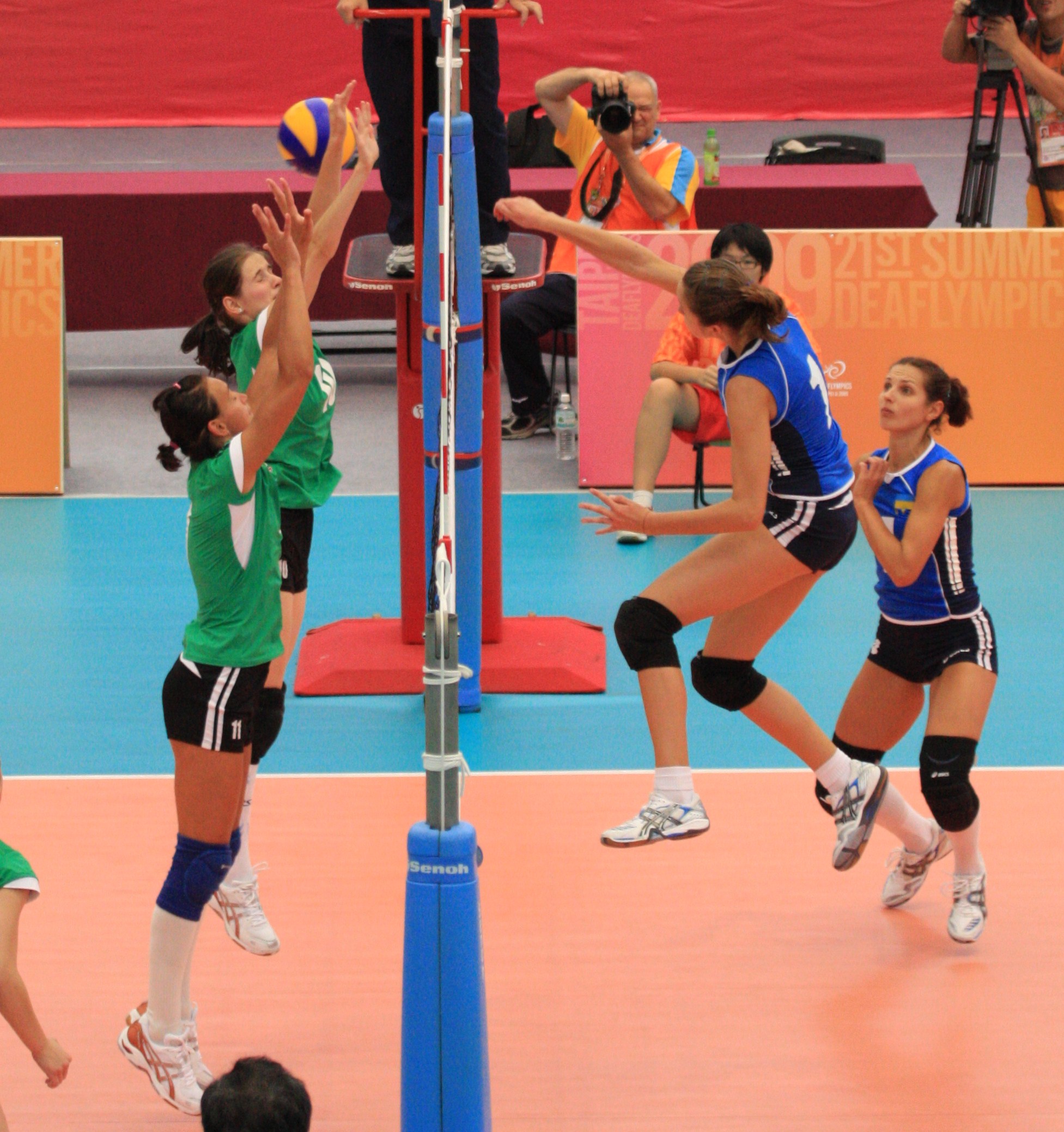
Deafness is a disability in sport – because people do not understand visual awareness.

In my latest book, Same Spirit Different Team I discuss the subject of deafness and how it affects high performance sport and I argue that we need more research into this area in order that people can understand the Deaflympics and Deaf sport itself.

The problem is, that non-deaf people find it very difficult to empathise with the difficulties of deafness – until it happens to them, and by then it is too late for the generations of deaf athletes who are missing out on the recognition and support that the Deaflympics and Deaf sport needs.

Image

Steve James’ article in The Telegraph “Six Nations 2014: England turn to disco lights to improve visual awareness” demonstrates that the inability of the England international rugby team being unable to hear each other at Twickenham has resulted in missed opportunities to score tries because of the increased noise levels from the Twickenham crowds. The coaches are calling it a lack of visual awareness. Mike Catt is experimenting with disco lights to try and improve player performance.

The England players are temporarily disabled, because they cannot hear each other. Their performances are compromised. The coaching staff do not understand visual awareness and how to develop it naturally.

The solutions to the problem are much closer to home, and the people with the knowledge to help have already played at international level – but they don’t realise that they are the solution. Ben Cohen MBE (England 2000-2006) and Matthew Gilbert (flanker currently with Bath) are the players that Stuart Lancaster needs to turn to for help.

However, as i explain in the book, due to the stigmatisation of deafness and the impact that this has on sports performance, both Cohen and Gilbert have suppressed their innate abilities and therefore do not have an acquired understanding of the ‘super power‘ within themselves.

As Andy Palmer, writing for the Limping Chicken explains, the England coaching team need to consult with the England Deaf Rugby team as they can learn from them. Lyndon James, secretary of the England Deaf Rugby Union explained to Palmer that by learning sign language high performance athletes will improve their visual awareness. I might add that they need to create their own system of signs that cannot be intercepted by the opposition.

sports coach UK currently provides a workshop “Effective Communication” which is based on the non-verbal communication skills innate in deaf and non-deaf people that can be enhanced to improve sports performance. This workshop has been designed by myself, representing UK Deaf Sport in partnership with the NDCS and sports coach UK. Feedback from participants is having the desired effect that i intended the workshop to produce – not only do delegates develop a realisation that these skills give them a little more confidence to work with deaf performers but they can be applied to everyone that they coach.

The disco lights might have an outside chance to improve the peripheral vision of players and lead to a few more tries, but they have much much more to gain by developing their non-verbal skills which will lead to enhanced visual awareness – a much more natural state of performance development.

The first step is to get Stuart Lancaster and the entire England coaching staff onto the sports coach UK workshop along with the England Deaf rugby team and they will realise within three hours what their solutions are.

I have briefly mentioned here that is not only a physiological problem – the impact of being unable to hear, but it is also a sociological problem – the stigmatisation of deafness. The impact of Milan 1880 and the difficulties of accepting deafness has far reaching implications for deaf people in sport. The book Same Spirit Different Team is a must read if you want to know more about this fascinating subject.

Ex England and New Zealand international Jamie Salmon is already reading his copy of Same Spirit Different Team – who will he help first England or New Zealand ?

Image

IPC refutes Deaf comments about 2012 Paralympics

There was an interesting article by Joel Hammer on the BBC Sports website this week discussing the accessibility of the 2012 Paralympics in relation to Deaf spectators and athletes.

The headline ran with Craig Crowley’s comment that some people were made to feel like ‘second-class’ citizens when the attended or participated in the 2012 Paralympics.

The IPC responded on the defensive as an IPC spokesperson “we refute any allegation.”

The IPC refuse to accept the comment that deaf people felt like ‘second-class’ citizens because “absolutely no concerns were expressed to the IPC from deaf athletes or spectators before, during or after London 2012.” and on that basis no deaf people were made to feel like second-class citizens “at the best Paralympic Games ever.”

This is a rather unfortunate response from the IPC, especially as Craig Crowley was diplomatic in in comments on the BBC Sports Hour programme because he did commend the efforts that the organisers had made to improve communication and accessibility but they were still not ‘offered on a full basis’. Crowley justified his comments because in his role as president of the ICSD, he had the opportunity to tour the athletes village and attend some events and in his conversations with people he received feedback that prompted him to suggest that people felt treated like second-class citizens.

Is the IPC really not willing to accept criticism ?

According to their spokesperson they have never received any complains – and so according to them, Crowley is wrong. But the facts speak for themselves – people have spoken to Crowley and shared their experiences with him. I have also gathered comments from others who were also at the Games – athletes, officials and volunteers which suggest that if the ICSD is going to be able to make any progress in discussing the possibility of agreeing to have Deaflympic athletes and sports in the Paralympics, then they really have got their work cut out because it would appear, from the response we read this week, that the IPC are going to be difficult to negotiate with.

LOCOG themselves published a report on the accessibility of the Olympics and Paralympics in 2012, it makes interesting and extremely positive reading. Whilst it does not reveal any negative criticism, the recommendations in the report do suggest that there were things that were not ideal and thus the report has listed ways in which future world class event organisers can accommodate and include spectators to avoid treating them as ‘second-class’.

In my role at UK Deaf Sport am looking forward to joining my colleagues and discussing matters of accessibility and inclusion with representatives of the British Paralympic Association as soon as possible in order that we can help them improve things for deaf athletes who already qualify to compete under IPC classifications. Our discussions will be constructive, but they will also be frank and at times uncomfortable. They will include testimonials from athletes, volunteers and officials who were at the 2012 Paralympics and the recommendations of the LOCOG report. I am confident that we can work collaboratively for the benefit of deaf people in sport.

Does this mean that we will be asking for Deaflympic athletes to be included in future Paralympic Games ? Realistically, it is not a matter than can be resolved and agreed at one meeting. The politics and structures of the Olympic family are contrived and will take time. Through these discussions and meetings we will all be able to look to the future possibilities and determine what can be achieved in the best interest of deaf people in sport.

It is rather difficult to explain everything here on the blog. For more information and in-depth discussions about the relationships between the ICSD, IPC and IOC and the issues that will need to be covered in terms of potentially taking the ICSD back into the IPC and entering athletes into the Paralympics under a Deaf classification, you can read Same Spirit Different Team a new book, which will be released for sale shortly. You can order your copy here.

Would you like to contribute to our discussions with the IPC and BPA ? Did you attend the 2012 Paralympics as a spectator, athlete or official ? You are welcome to share your comments here both or you can email in confidence to me at my UKDS email sharrison@ukdeafsport.org.uk.

Let’s do the right thing.

The BBC asks questions about the Deaflympics

As Russia announced that they will be hosting the 2015 Winter Deaflympics, the BBC interviewed a discussion with former ICSD President Craig Crowley and Andy Palmer, Deputy Editor of the deaf news website The Limping Chicken.

A transcript of the radio discussion is available

They discussed:

  • The importance in difference between the Deaflympics and the Paralympics and the reason for separate games.
  • The big question : Are we Deaf or Disabled?
  • The relationship between the ICSD and the IPC and the pros and cons.
  • The concerns about ‘time running out for Deaf sport’ if it does not deal with the question about Deaflympics and Paralympics.

As with many other important questions like this, there is never enough time in a radio show to really cover everything in detail. Fortunately, the latest book on the Deaflympics,  Same Spirit Different Team  allows you to read up further on the topics raised in the show.

Image

The book is proving popular in the UK and also overseas. International readers have been having difficulty placing orders over the internet but fortunately the publishers have now been able to deal with the technical issues involved and they hope that the problem has now been solved.

The book is available to pre-order


Deaflympics Winter Games 2015 are to go ahead.

We congratulate ICSD on their success to confirm that the Russian Government has pledged it;s support for the next Deaflympic Winter Games to take place from February 27 to March 7, 2015 in Khanty-Mansiysk.

Image

Picture – Khanty-Mansiysk, is located in an oil-rich regions of Russia

Presentation Meeting 14th January – ICSD President Rukhledev in his role as Honourary President of the Russian Committee of Deaf Sports and Mrs Komarova, Governor of Khanty-Mansi Autonomous Area-Yugra made presentations to the committee Russian international sports competitions which comes under the chair of the Deputy prime Minister of Russia Mr Kozak.

It is reassuring to see ICSD, at the very least, confirming that there is national and local government support for Deaflympic events. The finer details of the agreement are not known at this time as the Russian Committee of Deaf Sports, who are the event host will send all the necessary supporting documents to ICSD as due process within a couple of weeks.

Proposed events in 2015 – Athletes and their coaches can now prepare for the following events cross-country skiing, snowboarding, curling alpine skiing and ice hockey – again all this will be confirmed by ICSD in due course.  If you are not already affiliated to a national Deaflympic team and you wish to be considered for any of the events, you can contact you national deaf sports organisation. If you are eligible to represent Great Britain you can contact the UKDS National Talent Officer.

There was some concern about the ICSD Presidents potential conflict of interests whilst still holding a post within the Russian Deaf Sports Association. It has been clarified that he holds an Honorary Presidential role which suggests that he does not have any direct operational involvement in the RSDA. Mr Alexander Romantsov is President of the RSDA.

Historically, the Deaflympic Games has enjoyed very little economic and media support – and this is especially so for the less well-known Winter Deaflympics. It will be interesting to see if the relationships between the Russian Committee of Deaf Sports, its government and the Regional Governors office can emulate the City of Taipei and their coverage of the 2009 Summer Deaflympics.

The role of governments, the media and other agencies and the promotion of the Summer and Winter Deaflympics can be found in a new book due to be released in a few weeks. Same Spirit Different Team, to be published by AD Books.

The Retreat to Moscow

The contracts of the full -time staff at ICSD have just been terminated. Image

Mark Cooper (CEO) and Roanna Simmons (Operations Manager) have lost their jobs because the ICSD claims its financial situation is in decline.

Despite announcing last October, that they were planning to relocate to Switzerland in order to have ‘neighbourly’ contact with the IOC, they have now retreated to Moscow. the ICSD has now decamped to an office within the National Association of the Deaf of the Russian Federation and Mr Dmitry Rebrov, who works at the National Association has been given a temporary appointment to replace Cooper. These changes are subject to approval of the ICSD Executive Committee.

The ICSD apparently held a meeting with the Russian Federation government on January 14th to seek their final approval for the 18th Winter Deaflympics in Khanty-Mansiysk 2015. So far, no announcements have been made. There is speculation that there will be a repeat of the 2011 cancellation of the Winter Deaflympics when the event organiser was subsequently imprisoned for misappropriation of funds.

The world sports community is about to see the publication of a new book on the Deaflympics that discusses the importance of strong  leadership within the ICSD, the Deaflympic Movement and its relationships with the IOC/IPC and national committees, it also argues that Deaf sport must have a effective working relationship with non-deaf sports organisations and individuals.

You can now order you copy of Same Spirit Different Team from the publishers.


Are We Going to the Paralympics?

Since the media misquoted IPC president Sir Philip Craven recently over reports that Deaf sports would be in the Tokyo 2020 Paralympics I have been asked what is going on.

When i first read Craven’s comments I was doubtful about the accuracy of the report because those of us participating in international deaf sports politics know that the relationship between the IPC and the ICSD has not developed to the point where such agreements would be possible. 

The IOC recognises the Deaflympics as an event of equal status to the Paralympics. However, they have chosen, to put all their support, resources and energies behind the Paralympics and since 2001 the IOC and IPC have jointly organised their events together. This has meant millions of dollars from the IOC going into the IPC budget whilst a few thousands has been given to the ICSD.

A new book ‘Same Spirit, Different Team – The Politicalisation of the Deaflympics‘ will be available soon and will throw some light on the complex issues within the Olympic family of events, organisations and people. This book will be available from AD Books you can register for your copy here.Image