Why are Deaflympians treated so differently ? Part 1

In July this year, Craig Crowley MBE, President of the International Committee of Sport for the Deaf (ICSD) said that it was “bittersweet” that London was hosting the 2012 Olympics and Paralympics because deaf sport has become more isolated in recent years.

Seven years ago, Dame Kelly Holmes was screaming and punching the air in Trafalgar Square on hearing the news that London had won the IOC vote to host the Olympic and Paralympics. At that moment, Craig and I shared a dream that the Deaflympics was at last going to get some recognition here in the UK.

That morning I was giving a presentation at Oak Lodge School for the Deaf in South London, our Deaflympic gold medalist Joanne Davison was with me as we spoke to the children about the 2005 Deaflympics in Melbourne and how Joanne won her medal. I even took the opportunity to announce that London had won the 2012 bid – the whole school erupted in joy – along with the rest of the country. But our nightmare was just beginning.

In 2005, UK Deaf Sport was on a high, returning from a very successful Deaflympics in Melbourne and working closer towards the targets that we had set ourselves with the financial support from UK Sport. We were confident that with comparatively smaller funding than the Paralympians we were going to continue improving for Taiwan 2009 and beyond.

In 2008, UK Sport announced that the Deaflympics were not going to feature in their seven-year plan for 2012. Along with nine sports, UK Deaf Sports funding ceased.

Personally I could understand why they had to cut nine sports in favour of others. But UK Deaf Sport is not a single sport. To treat the whole of the UK deaf sports landscape in that way not only affected sport, It affected the deaf community as a whole. That community anger and bewilderment is still simmering today – evident in comments made in various media

UK Deaf Sport challenged the decision at UK Sport Resolution but it was rejected and the organisation could not continue with an appeal because it did not have the financial capacity to do so.

Deaflympian, Oliver Monksfield took the issue up with his local MP, Ian Duncan Smith, who raised the matter in Westminster Hall on 16th June 2009  and asked the Sports Minister Gerry Sutcliffe to reply. Sutcliffe argued that:

“UK Sport’s policy does not discriminate against deaf people or hard of hearing athletes. Deaf athletes who meet the criteria for UK Sports world-class performance programme in either Olympic or Paralympic sport will be supported. There are currently three athletes in the programme who are deaf or have declared a hearing impairment. In the past, the programme included Antonio Ally who competed in the 2004 Olympics. “

In reality what they are funding is a two-tier performance pathway. The Paralympics feeding into the Olympics. Long before Oscar Pistorius there was Catherine Du Toit  moving up from Paralympic to Olympic swimming. We almost had our own Paralympian Sarah Storey break into the GB Olympic cycling squad – this only happened because funding is available for Paralympians. It is most likely that more Deaflympians would break into the Olympic teams if there was funding in place for them.  The argument goes, that if Antonio Ally can get into an Olympic team, then there is no need to fund Sarah for the Paralympics because like Antonio she does not need it. Of course she does, and so do our Deaflympic athletes.

The UK government wants to see Deaflympians compete in the Paralympics. But that is not going to happen just yet, it is not a decision for UK Deaf Sport to make. It is up to the realms of the IPC and ICSD to work out a solution. So in the meantime they need to fund the GB Deaflympics team, it will cost less than 1% of the GB Paralympic budget to send a full Deaflympics team to Sofia in 2013.

This first part has all been about Deaflympians being treated differently by money and financial priorities. Tomorrow is the second part – other reasons why Deaflympians are treated so differently.

Two Big Ears has not been out and about very much today because at the behest of readers of this blog, Two Big Ears has been creating BSL versions to go alongside the written word. Please be patient with Two Big Ears whilst we find time to bring the BSL videos up to date.

Current videos are: Big Ears is Born, Opening Ceremonies, Ear we go and Batty at the Belfry

Why are the Deaf not in the Paralympics?

Liz Jones has created a storm of responses to her article in yesterday’s Mail on SundayI’m Profoundly deaf, so why cant I be in the Paralympics?”  Readers were challenging her claims about being Profoundly deaf, or criticising her lack of research on the subject of deaf sport. Others wondering why deaf sport was not doing enough to get into the Paralympics and others had commented on the “invisibility” of Deafness.

Two Big Ears raises public awareness that by remaining “hidden”, deaf people continue to “Get a raw deal.”

For those who think Deaf sport should be doing more to work with the Paralympic movement. I can bring everyone up to speed with the relationship between ICSD (Deaflympics) and IPC (Paralympics).

The ICSD was admitted into the IOC in 1955 as an International Federation with Olympic Standing. The Olympic flag has flown alongside the Deaflympic flag since 1985.

By the 1990s it was becoming increasingly more expensive to host the Deaflympics and to participate in them. Therefore at the behest of its international membership, the ICSD approached the IPC to examine the possibility of joining the IPC to help reduce costs, but also to take advantage of the high public profile that the Paralympics were attracting. The IOC was also keen for this partnership to take place.

However, because of the communication requirements of Deaflympians, the prohibitive costs to the IPC of providing sign language interpreters and the inability of the Paralympic games to accommodate the growing number of Deaflympians, the ICSD took the decision to withdraw its membership from the IPC. Other reasons for withdrawing were that the ICSD could not support the elimination of  the number of sporting events that would be offered to deaf athletes.

In November 2004, the IPC and ICSD signed a memorandum of understanding in the hope of creating a collaborative landscape in international competition and a clear understanding of the roles and responsibilities as separate organisations. Through the MOU, ICSD and its members , including UK Deaf Sport encourages deaf athletes with additional disabilities to compete in IPC events and conversely multi-disabled athletes who are deaf to compete in Deaf World Championships. In addition, the agreement was also to mutually recognise each others autonomy as organisations and co-operating to address conflicts between affiliated organisations.

However, there is still some way to go before Paralympians like this week’s Equestrian bronze medalist Laurentia Tan, a deaf woman with Cerebral Palsy will feel fully included in the Paralympic Games. A couple of months ago, I exchanged emails with Laurentia and asked her to describe the Paralympics from a deaf persons perspective. Now, for the record,we are talking about someone who requires BSL interpreters.

Yes, I was an individual rider but now we have a team of para riders so there is a bigger number of people involved.  Since we now have a team of para riders, I have booked interpreters to accompany me to all international competitions and it has really made a positive difference to my experience.  However, my parents and I have had to pay interpreters’ fees, and I am trying to sort out sponsorship / funding for this.   

I also remember during the Beijing 2008 Paralympic Games, when I joined the rest of the Singapore Team (i.e. swimmers, athletics, sailors and other Team officials) I found it really difficult to understand what was going on and had to rely on my parents and coach to help with communication.  

I have explained to my National Federation (Singapore) about needing a ‘team’ of interpreters so that they can work to cover the whole period required.  I also know how difficult it is to book interpreters so it is possible I will require a ‘team’ of interpreters.  However, I am aware that there are only so many places for accreditation and I was wondering if LOCOG will be able to assist in sorting out accreditation for the ‘team’ of interpreters to ensure that I have an interpreter with me for the required period.”

Unfortunately, when UK Deaf Sport got in contact with LOCOG (indirectly through intermediaries), they were told that this was not a GB issue and that LT needed to take it up with the Singapore Paralympic Association.

Now, at the time, I thought that was a fair enough reason to give. After all its bad enough that EDF Energy customers here in the UK were funding French athletes to win Olympic gold medals! Until one day, I was watching the Olympic Taekwondo on TV and there we could see, “british” volunteers massaging and applying ice packs to non-GB players during time out periods. Surely it was not too much for LOCOG to accommodate LaurentiaNational Lottery’s needs in the same way?

Looking back at the attempts by ICSD to merge into the IPC in the 1990s. Things were very different in those days. John Major was just about to fund sport via the National Lottery and the Paralympics were still relatively unknown. So, perhaps its time to have another meet at the table. Other major disability groups now have their own multi-event World Games which feed into the Paralympics. Perhaps this is now time for Deaflympians to try and do the same?

It has been suggested that ICSD try and negotiate for a small number of sports to be included in the Paralympics and then have the Deaflympics as a feeder event but because it was recognised as part of the Paralympic pathway and family it will make it easier to attract sponsorship etc and that Deaflympians can become part of the UK performance elite. perhaps it could also explore the inclusion of a hard of hearing classification alongside the 55dB threshold, that we discussed yesterday?

In 2005 UKDS lost its Deaflympic funding from the government in order for it to enable the country to prepare of the 2012 Paralympics. UKDS argued that GB Deaflympians were being discriminated against in favour of others. Iain Duncan Smith raised a debate in the House of Commons and the government of the day (Labour) argued that it was not discriminating against deaf people and used the example of Antonio Ally, a british deaf diver being able to compete at Olympic level and gain lottery support. We will discuss this further tomorrow.

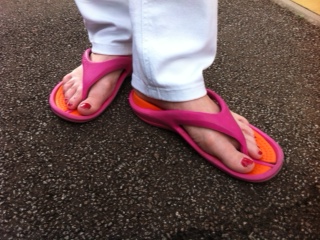
Yesterday, whilst we were out, Two Big Ears II asked me if her shoes were suitable to wear out in public. I took one look at her feet and then pointed to her Two Big Ears. “You are quite comfortable to be seen in public wearing Two Big Ears and your worrying about your shoes?”. Joanne has become quite attached to her Two Big Ears. We met people in Fosse Park, Leicester today and handed out ten Introductions

Don’t forget to make a contribution to help the GB Deaflympic team

Classifying Disability Sport

Sunday 2nd September:

BSL HERE 

As Vice Chair of UK Deaf Sport, I deal with many emails on a daily basis asking for advice, offering opinions etc on deaf sport. I am currently involved in a discussion with some deaf athletes over the validity of the 55dB rule. In the Deaflympics, all competitiors must have a hearing loss of 55dB in their better ear. The argument is that this threshold is too high and should be lowered to 35dB.

I started drafting this blog earlier this afternoon using the story of GB Paralympian swimmer  Ellie Simmonds winning gold on Saturday in the S6 400m freestyle against the American Victoria Arlen who was declared ineligible after tests suggested that she was not disabled enough. The US appealed and Arlen was reinstated.

By coincidence, as I was putting finishing touches to this blog, I have just watched Alan Oliviaria fly past Oscar Pistorius in the T43/T44 200m final. Pistorius was well ahead with about 75m to go and then Oliveria glided past him to win. Mondays news headlines will be “Has Oliveria cheated?”

Joanne, my number two Two Big Ears has pointed out that the other runners in the race with one normal leg are unable to change the length of their blades, suggesting that the IPC need to tighten up the rules.

Many deaf sportsmen and women will have their jaws on the floor at the suggestion of lowering to 35dB – as it was also my immediate reaction earlier this week when I read the emails coming through my in-box. However, I am open to suggestions and asked the 35dB campaigners to give me evidence/reasoning to support their case.

The arguments for 35dB :

a) Is there scientific evidence to back up the rationale for 55dB ?.

b) Deaf sport is struggling to attract more athletes to events, the small turnouts would be increased by lowering to 35dB. In some sports, countries are unable to field teams as they cannot find enough elite athletes at 55dB.

c) Deaf sport at 55dB is struggling to attract commercial sponsors because it is not reflecting a large enough market.

d) Deaf sport could be like the Paralympics with different classes of difficulty such as in the 200m race this evening with T43 and T44 athletes.

e) In deaf sport  athletes are not allowed to wear their hearing aids or cochlear implants during competition, in order to level the playing field and not give anyone an advantage through technology. Quite the opposite to the 200m race tonight, where people are taking advantage of technology to go faster. Deaf people should be allowed to take advantage of either wearing or removing technology, a personal choice.

The arguments for 55dB :

a) Lowering the threshold would allow non-signing athletes into the sport and because sign language users are in the minority, the problems of communication would soon mirror daily life as more and more partially-hearing people get involved and the profoundly deaf are marginalised. Disempowering those for whom deaf sport is organised.

b) The original games in 1924 The Silent Games were conceived by a Frenchman and a Belgian, both deaf sportsmen, who wanted to make a stand against societal misconception of deafness of the day. Unfortunately, despite many advances, Deafness remains a hidden disability and greatly misunderstood.

c) Many disabled people are excluded from the Paralympic games because of the classifications system. They do not mirror the social model of disability. They do not empower severely disabled people. By maintaining a higher threshold of 55dB, deaf sport is safeguarding opportunities for deaf people who are marginalised in life. Deaf sport is empowering and ‘hearing” society has much to learn from this.

d) Deaf sport is managed, lead by deaf people for deaf people and therefore truly empowering not only for athletes but for officials and volunteers who also have minimal opportunity in mainstream sport. The 55dB threshold is a self-imposed rule and not by “hearing” society.

What do you think?

Channel 4 “The Last leg with Adam Hills” they are all saying that “disabled” is outdated. They are not considering that technology, classifications, running guides etc make it easier and possible to perform at your very best and within the rules of Paralympic sport. Unfortunately the rest of the planet is not set up in the same way so the war veterans breaking Paralympic records cannot be ordered to go back to another tour in Afghanistan because they are disabled.

In the Deaflympic games there are no communication barriers, this empowers deaf people who experience the Olympic ideals in a way that would be impossible in the Paralympics or Olympics. More on this tomorrow – when I discuss the case of deaf athletes who have won medals in the Olympics and the Paralympics.

GET YOUR BSL VERSION HERE

Finally, before I sign off, thank you to Rita and all her colleagues at Furniture Village, J9 Retail Park, Wednesbury for taking a keen interest in Two Big Ears. Rita took two copies of the Introduction – one for herself and the other to post on the staff kitchen. Thank you for your support.

Corrective Surgery and Local Sports clubs

Apologies for the late arrival of this post, should have been up yesterday.
I imagine at some point that everyone with a “spare part” – Hearing aid, cochlear implant, prosthetic limb, glass eyes, wheelchairs, dentures etc has felt the urge to, or had to, undertake some form of DIY modification to make the offending article work; sit comfortably; stop hurting – whatever.
Yesterday I carried out some corrective surgery on Two Big Ears because I have a deformed right pinna due to a mild form of Treacher Collins Syndrome – the right side Big Ear will not stay in place.
Like all good pioneers, I am not going to reveal my medical secrets as it might be a breakthrough for deaf people and earn me untold riches from the NHS or private health. I am going to test it out for a while. But what I can tell you is that the procedure only requires a ballpoint pen and two elastic bands – go figure.
Yesterdays experiences got me thinking that getting children and young people into sport, local sport clubs. Is a bit like corrective surgery.
Joanne and I have been looking after her eight and ten year old grandsons this weekend. On the way over to see them yesterday, Joanne wondered If the two pairs of Two BIg Ears would freak them out and would we get permission from the eight-year-old to allow Two Big Ears to take him to his weekly Taekwondo lessons.
There was no freak out. eight-year-old loved Joanne’s Two Big Ears and tried them on for size. My Two Big Ears were “embarrassing” , nevertheless less I persuaded him to let me keep them on and promised to explain why I was wearing them in the car on the way to “kick someone in the head”.
Try to imagine the stunned expression on the faces of coaches, parents and athletes as we walked in to the gym. I really would like to know if that’s the same reaction disabled people still get today when they turn up announced at a local sports activity and hope to join in? Just think about it, what must that feel like for everyone.
Don’t get the wrong end of the story here, the guys at West Midlands Taekwondo are fantastic. I quickly got them out of their misery by announcing that I was with eight-year-old and I had £10 for his subs.

Normal service quickly resumed and I really enjoyed watching my first Taekwondo lesson, there were five little people with laser sharp focus, taking in every instruction from coach Mike Meese. Inspiring to watch a child being taught the basic foot movements and another carry out intricate arm blocks and punches. Only 10,000 hours away from their first world championship medal?

Of course, I made my daily contribution for the GB Deaflympics team I gave one of the mum’s and Mrs Meese a copy of the Introduction…
I would like your permission to allow me to share my inner thoughts as I watched that lesson, after all, that is the purpose of this blog.
There was a girl training with eight-year-old who had a physical disability – I wave hands in the air for her dad for including her in his sport. Many children born with disabilities are not given these precious life chances to enjoy sport. Her movements are restricted so she could not show the finese of of the others, but we could all see her for what she was and proud of what she was doing.
But this did make me wonder about the “hidden disability” of deafness. Instructions were given verbally in a mixture of Korean and English alongside a demonstration of the movement required. Had a deaf child turned up yesterday morning, the coaching methodology would have been insufficient to make sure that the child was able to follow what was going on. But I have my utmost faith in Mrs and Mrs Meese and the other members of WMTKD that they would make the necessary adaptation for the deaf child. They have my UK Deaf Sport business card, they can contact us as soon as a deaf person joins their club, we will be there to help them.
UK Deaf Sport is working in partnership with sports coach UK and the National Deaf Childrens Society we are currently developing a new workshop on communication skills for sports coaches which will be piloted later this year with a launch in the spring – if all goes well, I look forward to personally delivering the workshop to everyone at WMTKD.
First impressions really do count, imagine an astute parent of a deaf child turning up to yesterday’s lesson and making a personal assessment on its suitability for their child.
On the basis of what I saw yesterday, they would probably not return the following week. Parents of deaf children have a point of view quite different from mine, I am pre-lingually Deaf and a fully qualified PE teacher, sports coach, coach tutor so have my perspective on things. Parents are experts on their own children but not necessarily experts on inclusive sport for disabled children.
When eight-year-old and I got back home, Mum and Dad were almost ready to leave for their well deserved weekend break. Dad and I had a chat about the lesson and his hopes for both his boys. I learnt that Dad had taken 10-year-old to the local Sea Cadets but decided from his point of view that there was something not quite right about the group, it made him feel uncomfortable, so they are looking for something else to do. First impressions, rightly or wrongly are powerful – we, in sport have to get it right first time otherwise we risk losing newcomers.
There is a boxing club I know who have an excellent approach to first time visitors and I assume it is also replicated at all ABCs – I hope. Both parent and child are invited to observe their first session, if the child is straining at the leash to have a go, they can. When Joanne’s son showed an interest in the sport we took him along to the club to observe.
The volunteers at the club explained everything to us, showed us around the venue etc, made as all feel welcome. But, we never went back. Although the club explained that they had worked with another deaf child before, this did not persuade our 14 year old. He was concerned about the enormity of the communication issues facing him. It was his own personal impression of what he saw.
If I had not been there, Joanne would not have taken her son because there was nobody to communicate with them. If there had been another deaf person at the club, (volunteer, boxer, coach, or parent) – then there would have been a higher possibility of him returning to give it a go.
It’s human nature, we all want to be with people like ourselves. There has to be a common denominator that compels us to join a new club, but sometimes the sport itself is not enough.
Deaf people need someone that they can communicate with. The little girl I admired yesterday, her father is a player – Taekwondo is a family thing.
In the beginning, 8-year-old had to be told he was going to his lessons, it was not out of choice, even now, Mum and Dad have to make sure he’s ready to go and take him there. They do this because they want him to have the best chances in life, they believe that sport is a force for good.
Getting disabled children involved in a local sports club is a bit like corrective surgery, get it wrong and you are psycologically scarred, sometimes for life and the task becomes much harder.

George Elliot’s stones

I promised in my first post that if you keep in touch with the blog I will explain the reason for Two Big Ears. What I will say now is that its not going to be possible to explain it all on one post as there are going to be so many different perspectives to take on this. But ultimately, it is about educating and making people aware of the Deaflympics, UK Deaf Sport and related issues.
In my daily work, I am always telling people what I do.  I can explain it all to one person only to find a few minutes later I am saying something completely different to the next person. This is because we are all human and when we interact with each other we say things that will enable us to make the quickest connection and get our messages across.
But we do need to have consistency in messages, especially if there are important points to get across to people.

This is what I use at work

So, with that in mind, I have created a fact sheet – well, that’s what I have been calling it. But in reality it is an “Introduction” so thats what I am calling it from now on – you can read a copy of the introduction that we have been handing out to people here.

So, enough of the background static… I know you are dying to know what happened today..

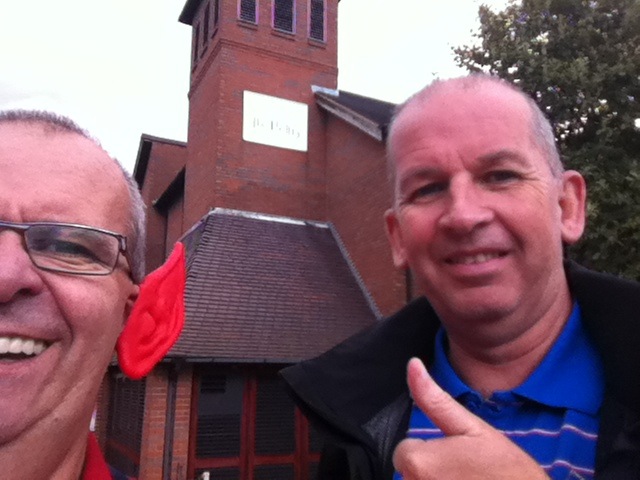
You don’t know how pleased I am to tell you that my gorgeous wife Joanne has now got Two Big Ears! We have been out together today and she has been wearing her TBEs with me.

Our first port of call was George Eliot Hospital – I have been going there on and off for almost two years now trying to get rid of a troublesome kidney stone. Its a really painful bugger when it moves! The treatment is really interesting, instead of cutting people open, they now apply ultrasound-waves to shock the stone and break it up into small pieces (lithotripsy). Sometimes is a quick solution but for others it can take several treatments before anything starts to shift – In my case I have needed three visits to the coal-face. Today, was finding out how things have progressed.
Joanne was in a fit of giggles as she noticed the many different reactions Two Big Ears provokes from people. In the car park, a bloke walking towards me did not notice anything at first because he was not looking, talking to his mate. As we got closer he started to look where he was going – he almost jumped out of his skin! – poor bloke! I gave him an introduction

Main out-patients reception, all the locals of George Eliot NHST can see this place in their minds eye – but for you outsiders- it a really busy place to be, we could feel all the eyes homed in on Two Big Ears! A nurse came up to us in the queue “Right then, I suppose there is a reason for all this is there?” I handed her the introduction “Have a look at this, please give us your support” – Response, “Ah, great, wonderful, I have a hearing aid too” and she pushed back her hair to show me.
Now, those of you dear and close to me will know that I have been in and out of hospitals all my life – we will keep all that for another time. Anyway, I am trying to say that NHS staff do their level best to help you especially if you are a regular, but when you are deaf its the same old problems each time….
But Two Big Ears has a really interesting affect on people. I asked the receptionist if they had booked my interpreter for the appointment. Unfortunately, nothing was in the book. But this time the lady went out of her way to the ‘transport’ office to double check for me! She came and found me in the waiting area and apologised that nothing had been organised. Its really frustrating when this happens, hospitals should have this type of information on file so that when BSL users have appointments, the interpreters are automatically booked. Maybe one day…
“I will just have to hope for the best” I told Joanne as we waited. I was thinking of the rigamarole of asking the Doc to repeat himself, or slow down or whatever. Yeah whatever…
We got called down to the consulting rooms – Dr Raaj was in the waiting area. “So whats it all about?” – I gave him an introduction…
We were quickly ushered into a consulting room and asked to wait… it felt like ages. Joanne suggested that they had moved us on quickly because they wanted Two Big Ears out of the way – quite possibly, or are we just being paranoid about the affect of Two Big Ears ?
The consultation was one of the very best I have had for years! I usually find Dr Raaj quite difficult to understand. But today he was a brilliant communicator! It was almost as if he had just done a crash course on Deaf Awareness, it was a great communication experience. He took great care to make sure we understood what was happening and gave me time to relay to Joanne.
In the end it was all brilliant news. You can see it in the photo – I will leave you to “spot the difference” in the images. The clue is “good news” 
On the way out of the hospital we got called over by the two ladies manning the Macmillan Information desk “What’s it all about?” – I handed them an introduction “Please have a look at this, we would like your support.” This time, instead of walking on, we decided to wait for their responses. “That’s a lovely idea, where can we get those ears ?” I am going back next week with two pairs of Two Big Ears for the Macmillan ladies and a stack of Introductions… thank you ladies!

This afternoon we were with some Deaf friends who were having their home valued by an estate agent, we talked about Two Big Ears, the agent read the Introduction, she explained that her father was deaf…

The young lady at the Macdonalds drive through… rabbit, headlights…. say no more…

To the car on the motorway, sorry if we made you take the wrong turning and swerve all over the road, you should have been looking at the road not Two Big Ears

Joanne: “These Two Big Ears are itchy”
Stuart: “Must be like that for amputees and their legs”

Finally, We had another brilliant piece of good news today for UK Deaf Sport and the 2013 Deaflympics, but I am not allowed to tell you yet… you have to keep watching this blog.

Please tell everyone to follow us – we need to convert people to understand deaf sport and the Deaflympics, tell them about Two Big Ears

Batty at the Belfry

First job of the day today – strategic planning meeting at The Belfry with Simon Kirkland of Sport Structures.

Public impressions? On the drive into The Belfry, I did wonder how the staff would react to Two Big Ears – would I be asked to remove them or leave quietly?  No problem. whatsoever. A group of ladies in the lobby saw Two Big Ears a mile away – must have been at least ten smiles in that group – I hope I made their day – I passed them a fact sheet….
Lovely couple walking past me, thanks for your smiles… fact sheet…

I found Simon in the Belfry Bar, all the business suits looking at me as i walked through. The looks on their faces….

I apologised to Simon for being 30 minutes late – explained that  had to find a pair of ears… “I cannot take you seriously with those things on”. But we did take it seriously the Two Big Ears provoked a deep conversation on the impact of last nights Opening ceremony etc.

Pass on the word Simon – you have a fact sheet….

GET YOUR BSL VERSION HERE

Ear we go!

Thanks to Ted at Clowning Around, Nuneaton for my new ears!
“my grandson is deaf” he told me.
Now we would never have made that connection otherwise.
I left him with a fact sheet

20120830-093407.jpg

GET YOUR BSL VERSION HERE

Opening Ceremonies

Watching Olympic/Paralympic opening ceremonies on TV, remind me how privileged I have been to walk out with the GB team at the 2005 Deaflympics in Melbourne, Australia. I know the feeling… even now, 7 years later I get emotional about it.

I have woken up this morning and prepared a fact sheet to hand out to people so that they might understand Two Big Ears.

I am waiting for the shops to open so I can go and buy my new ears. I am feeling utterly terrified of what I am about to do. Will people notice anything? Will it work? Its a bit like getting ready for a “Two Big ears Opening Ceremony”.

GET YOUR BSL VERSION HERE

Big Ears is born

Two Big Ears is my way of raising awareness about the Deaflympics.

Whilst we are all enjoying the London 2012 Paralympics, I am going to see how the public react to me wearing a pair of big ears everyday right up until the Paralympic flame goes out at the Closing Ceremony.

If you don’t quite understand what I am trying to do, please keep checking this blog as I will update my experiences daily and in the process, you will hopefully give the Deaflympics your support.

GET YOUR BSL VERSION HERE