Yet despite the wins, the global sports pages remain strangely quiet. The athletes are in motion. The record boards are ticking. The cameras? Still mostly pointing elsewhere.
If the Deaflympic movement has one job, it was to show the world they matter. Right now, they’re doing the work. The question: will the world show up?
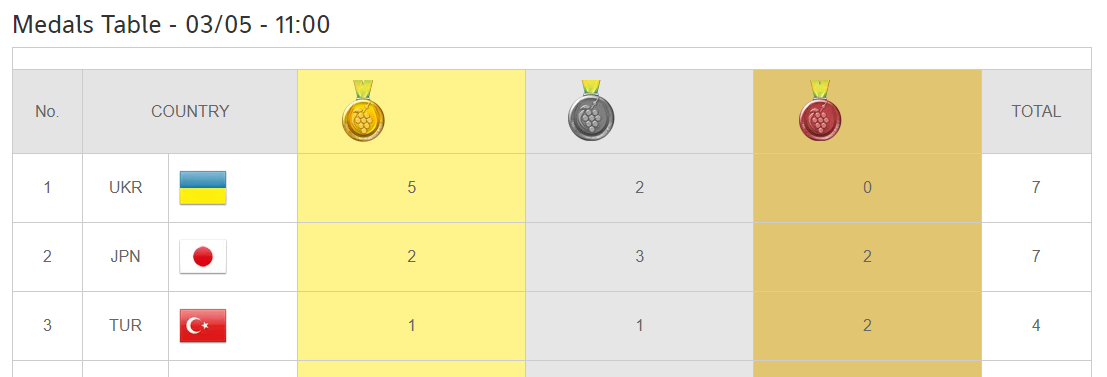
Bravo to the organising Committee for livestreaming, here’s the highlights for 19th November
As Great Britain and other nations prepare for the 2025 Summer Deaflympics in Tokyo in 306 days time, several challenges emerge, particularly when compared to nations that provide robust governmental recognition and funding for their deaf athletes.
Funding Disparities
In the UK, elite deaf athletes often receive less financial support than their counterparts in the Olympics and Paralympics. This lack of elite funding hinders their access to top-tier training facilities, coaching, and competition opportunities, potentially affecting performance levels. In contrast, countries with substantial government backing can offer their athletes comprehensive support, leading to a more conducive environment for success. Chris Ratcliffe, CEO of UK Deaf Sport explains to the BBC why “We have to fund the Deaflympics Ourselves”
Recognition and Awareness
The Deaflympics historically receive less media coverage and public attention in Great Britain compared to the Olympics and Paralympics. This limited visibility results in fewer sponsorship opportunities and a lack of public support, which are crucial for athlete development and morale. Nations that actively promote deaf sports and celebrate their athletes’ achievements tend to foster a more inclusive sporting culture.
Access to Training Facilities
Deaf athletes in the UK face challenges in accessing training facilities equipped to meet their specific needs. This includes the availability of sign language interpreters and coaches trained to work with deaf athletes. Without adequate facilities and support, athletes may struggle to reach their full potential. In contrast, countries with dedicated resources for deaf athletes can provide tailored training environments that enhance performance. It has been argued that there is coaching talent and experience within the Deaf sports community, that would provide the coaching and technical support required which then reduces the need for expensive interpreting and the deployment of coaches who may be highly qualified but lack the communication skills and cultural essence needed to lead in elite sport.
International Competition Experience
Limited funding and support can restrict opportunities for British deaf athletes to compete internationally, which is vital for gaining experience and improving performance. Regular exposure to international competitions allows athletes to benchmark against top competitors and adapt to different competitive environments. Countries that invest in sending their athletes to international events provide them with invaluable experience that can be advantageous during the Deaflympics.
Advocacy and Policy Support
The level of advocacy and policy support for deaf athletes varies between countries. In the UK, the #FairPlayforDeafAthletes campaign is advocating stronger policies form the Department of Culture, media and Sport that will ensure equal opportunities and support for deaf athletes. The UK may argue that the current economic climate makes it very difficult to provide such funding but this will not stand up against the commitments made by countries such as Ukraine whose resources are also engaged in the heroic defence of their territory in war with Russia.
Addressing these challenges requires a concerted effort from sports governing bodies, policymakers, and the community to ensure that British deaf athletes are adequately supported and prepared to compete on an equal footing with their international counterparts at the 2025 Summer Deaflympics in Tokyo.
The legal representatives of the Russian beach Volleyball athlete Rushan Dayanov have filed a lawsuit of slander to protect his honour and dignity against accusations made by Valery Rukhledev in a TV interview that he is in fact hearing and should not be competing in deaf sport.
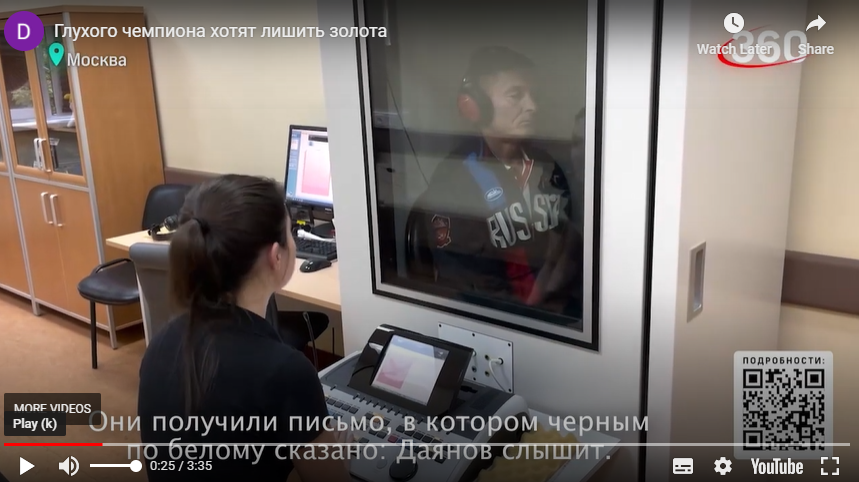
Extract from Video: Dayanov having an audiometry test (copyright DEAFNET)
We are grateful to readers of our website who have alerted us to this case. The information is available on the Russian website DEAFNET from October 2022. It also has a video of Dayanov as he has a hearing test to prove that his deafness meets ICSD standards of 55dB or more in the better ear.
The story came about after ICSD received an anonymous latter claiming that the athlete has fraudulently won a Beach Volleyball gold medal at the 2005 Deaflympics in Melbourne. Such accusation are very serious for Russian athletes because if they are disqualified, they not only lose their medal but also a pension from the government.
Dayanov and Ivanov at the medal ceremony (copyright DEAFNET)
Dayanov’s team-mate in the Beach Volleyball competition was Stanislav Ivanov the head of the All-Russian Society of the Deaf (VOG) which suggests that the letter was actually written by disgruntled former employees at VOG who have a vendetta against Ivanov and that Dayanov has become the scapegoat.
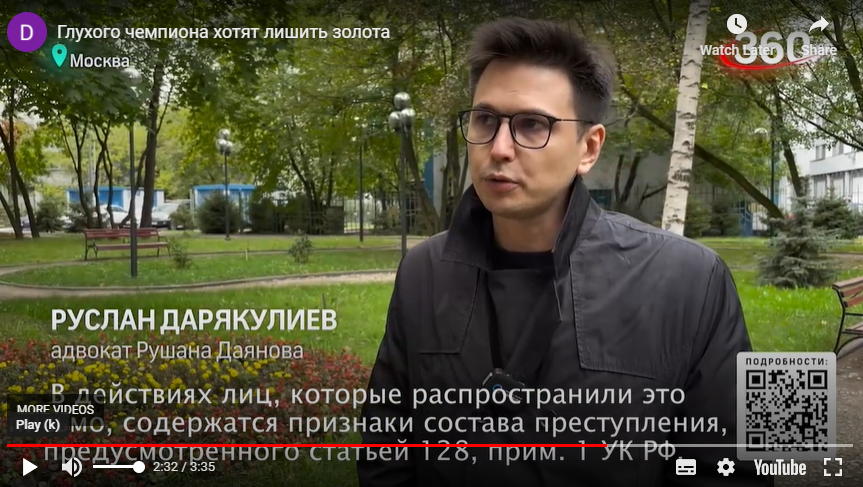
Ruslan Daryakuliev, Dayanov’s Lawyer (copyright DEAFNET)
The lawyer representing Dayanov claim to have irrefutable proof of his hearing loss and in the video, the athlete said “I achieved the championship with sweat and blood, worked hard for 20 years to deserve this prize- not only for myself, but first of all the country. This whole situation was an absolute shockfor me. I have nothing to hide. It hurts that for the sake of petty intrigues, swindlers are ready to break a persons life.”
The lawyer Daryakuliev promises that the response to slander would be ‘extremely harsh’. The defendants in the case are Rukhledev, the All-Russian Television of the Deaf and its editor in chief Alexander Soldatov. Applications have already been prepared to initiate criminal cases under the charge of ‘slander’.
Valery Rukhledev, former ICSD President speaking to All-Russian Deaf TV (copyright DEAFNET)
The video in the article shows Rukhledev talking to All-Russian Deaf TV “Dyanov spoke among the deaf, but in fact he is 100% hearing”. he speaks fluently and does not know sign language. This is already a global scandal.”
This case does raise issues around the proof that athletes require to compete in international deaf sports. In the athlete’s defence it has been explained that he has speech that is almost indistinguishable from that of hearing people because he did not become deaf until he was 10 years old after a serious illness. Comments on the website suggest that it may be very difficult to prove what his hearing was like in 2005, because Dayanov is now 62/63 years of age and likely that he would present such a level of deafness for his age.
The video showing Dayanov’s Deaflympic medals (Copyright DEAFNET)
His last Deaflympic competition was in 2017 when he won a bronze medal in the beach Volleyball.
The lawyer also argues that the Russian Deaflympic committee should not be undertaking disciplinary checks on the basis of an anonymous letter and should have taken measures to protect athletes from anonymous accusations and identifying the authors of such letters.
Russian Deaflympic team with President Putin (copyright DEAFNET)
We have no updates on this case, perhaps our readers will keep us informed?
Two Big Ears examines what’s inside the in-tray of the new leadership at ICSD and what are members expecting to happen.
The recent ICSD Congress in September 2022 elected a new governing board which is now led by President, Adam Kosa (Hungary) & Vice President World Sports, Yutaka Osugi (Japan).
ICSD President Adam Kosa
Members have banked on Kosa’s relevant experience as a Deaflympian, Member of the European Parliament and board member of the Hungarian Paralympic Committee to bring a steady, diplomatic and stable leadership to ICSD which has endured almost 10 years of unsteadiness, tactlessness and unpredictability.
There is an expectation that Kosa and Osugi will request an opportunity to meet with the International Paralympic Committee and discuss opportunties for positive partnerships and a closer relationship. Unlike the previous elected incumbent Rukhledev whose opinion was to stay away from the IPC and expect them to come running to his door.
We are already witnessing signs of professionalism and orderliness coming from the Secretariat, issuing notices for elections to the various Commissions (Anti-Doping, Audiology, Legal, Sports and Women in Sport). Information about the opening hours of business and best times for communications.
They have written decisive and timely reminders to International Deaf Sports Federations that due to the war in Ukraine, Belarusian athletes, coaches and managers are not permitted to compete in ICSD sanctioned events, Deaflympics and World Championships. It would appear that some organisers have still not understood the ‘news’ and have needed to be told twice.
Perhaps Kosa and Osugi can explain why they have decided to hold on to Dmitry Rebrov as CEO despite being guilty of one of the worst acts of Deaf sport criminality; the falsification of athletes audiograms in order to get them banned from European competitions.
There is also a high expectation that the 2025 Summer Deaflympics will benefit from the legacy of hosting Olympic/Paralympics in 2020 and the leadership of Osugi who has been a prominent leader in Japanese Deaf sport for two decades. Will Kosa and his team ensure that the games have a solid backing by government ministries, sound financials and that nothing is left to the last minute – which has been the norm by ICSD with very few exceptions. The Games will also give ICSD the opportunity to celebrate the upcoming 100th Anniversary of the Deaflympic Games in 2024.
That’s all for the short term, but what is Kosa’s vision for the long term? Perhaps you, our Big Ears readers might like to make comments below?
Its has been a week since the ICSD called for peace ahead of the 2021 Summer Deaflympics in Brazil and many are wondering what is happening about its Russian staff and the ongoing Court case.
The ICSD Board met on 5 March and in solidarity with their Ukraine members, agreed to follow the IOC, IPC and demands from its own members by banning all athletes and officials from Russia and Belarus from invitations or taking part in any international competitions on the ICSD calendar until further notice.
This years Summer Deaflympics are short on funds due to the number of countries who are not participating.
This decision will have an economic impact on this Summer’s Deaflympic games to be held in Brazil and it has been decided to cancel the Bowling programme because the technical requirements will need a heavy financial commitment which has been lost due to the number of countries who are not sending teams to compete as well as the banishment of Russia and Belarus.
Taipei have written to ICSD to say that it was an ‘unwise’ decision to cancel the bowling because athletes have been preparing for 4 – 4.5 years for the competition and they have requested that the ICSD reconsider its decision.
Meanwhile, National Sports Federations have been consulting with their governments for advice on how they should engage with International Federations which have significant Russian influence in their leadership. The ICSD’s Chief Executive, Dmitry Rebrov is Russian and people have been asking what should be done about his influence on Deaf sport especially due to the fact that he has been found guilty of falsifying audiograms and recently took control of ICSD by preventing the previously elected board from accessing their official ICSD emails and servers.
The ICSD and its CEO are now facing a challenge in court over the validity of the recent Extraordinary Congress in Switzerland where the new board was elected. The latest updates with letters and videos on the court case are available on Facebook.
National Deaf Sports federations who have been invited to participate will now decide whether or not to send athletes and teams to the next Summer Deaflympics in Brazil.
Immediately after the ICSD Extraordinary Congress in Switzerland last week, The ICSD officially invited all its member nations to take part in the 24th Summer Deaflympics from 1-15 May 2022 in Caxias do Sul, Brazil.
There are 21 sports currently listed on the programme and ICSD President Gustavo Perazzolo writes ‘We look forward to having you come down..’ Perazzolo himself is a former Brazilian Deaflympian in volleyball and cycling.
There are questions now facing National Deaf Sports Federations as they decide whether or not to participate in this event. Australia has already had to withdraw due to its government regulations on international travel which are already extended into 2022.
Travel restrictions will make it very expensive if athletes and their officials have to isolate at their own expense on return to their home countries. The outbreak of the new Omicron variant is set to have a severe impact on travel that could last well into 2022.
The state of Rio Grande do Sul does not have its own international airport and athletes will have to use internal flights to reach the local airport further increasing the risk of contamination by the virus and potentially the more transmittable Omicron.
Brazil currently has the second highest number of national recorded deaths due to Covid-19 and questions are being asked if the true number of deaths and cases are being recorded, the country currently at 615,570 deaths and 22.1 million cases nationally. President Jair Bolsonaro has told Brazilians to ‘stop whining‘ and has continued to downplay the virus. Brazil’s Supreme Court has opened an inquiry into claims made by Bolsonaro that Covid-19 vaccines may increase the chance of contracting Aids. One positive note to make in all of this is that the host state has one of the lowest number of deaths and cases so far in Brazil.
The official games website has a page showing some official Travel Insurance available, but neither that nor health insurance will give immunity to a virus – only a vaccine may do that.
For months now, national federation representatives have been asking the Deaflympic organisers to show that they are making arrangements to protect athletes from the virus as well as ensuring that the event will also have stringent Anti-doping checks and Audiogram checks in place.
Concerns about anti-doping and audiogram checks are long-standing as the CEO of ICSD, Dmitry Rebrov is Russian and has been found guilty by his country’s legal system of falsifying audiograms and ICSD have not followed the IOC and IPC in restricting how Russia can compete due to RUSADAs poor history of doping scandals. Last month’s World Short Course Swimming Championships had no in-competition anti-doping tests in place. When ICSD President Perazzolo was questioned about the lack of anti-doping tests he blamed the Polish organising committee and did not take responsibility for ICSD’s role in event planning oversight.
In recent weeks, CSD Head of Technical Commission, Martin Bogard has made presentations to his colleagues in the commission and to delegates at the Extraordinary Congress last week. We understand from comments being made by congress delegates that some of the sports sites may not be up to international standards which, if the claims are true, would make it difficult to validate any new Deaflympic Records set in the sports affected.
The IOC has continued to with hold its funding to ICSD in the wake of embezzlement scandals involving a former ICSD President and the umbrella organisation did not sanction the 2019 Winter Deaflympics and it remains to be seen what they will do for Caxias do Sul.
After viewing our interview with former ICSD President Craig Crowley, the most senior Technical Director in the ICSD has come on record to give you information about some of the concerns raised in our interview with Crowley
This post replaces the original which we had to remove due to video tech issues. We apologise for the earlier trouble you may have expereinced in trying to download.
This interview was recorded on 30th July 2021. It is accessible partly in BSL and International Sign and supported with English subtitles.
Last week Gustavo Perozzolo, ICSD Interim President wrote to national members to request ‘calm and focus’ in response to ongoing concerns and criticisms. In reply, former ICSD President Craig Crowley has made a video reply to the letter to raise concerns about its content and the current situation of next year’s Summer Deaflympics.
Craig Crowley approached Two Big Ears and requested that we publish his concerns. This video interview is presented in BSL, International Sign and supported with English subtitles.




 Two Big Ears