Sunday 2nd September:
BSL HERE
As Vice Chair of UK Deaf Sport, I deal with many emails on a daily basis asking for advice, offering opinions etc on deaf sport. I am currently involved in a discussion with some deaf athletes over the validity of the 55dB rule. In the Deaflympics, all competitiors must have a hearing loss of 55dB in their better ear. The argument is that this threshold is too high and should be lowered to 35dB.
I started drafting this blog earlier this afternoon using the story of GB Paralympian swimmer Ellie Simmonds winning gold on Saturday in the S6 400m freestyle against the American Victoria Arlen who was declared ineligible after tests suggested that she was not disabled enough. The US appealed and Arlen was reinstated.
By coincidence, as I was putting finishing touches to this blog, I have just watched Alan Oliviaria fly past Oscar Pistorius in the T43/T44 200m final. Pistorius was well ahead with about 75m to go and then Oliveria glided past him to win. Mondays news headlines will be “Has Oliveria cheated?”
Joanne, my number two Two Big Ears has pointed out that the other runners in the race with one normal leg are unable to change the length of their blades, suggesting that the IPC need to tighten up the rules.
Many deaf sportsmen and women will have their jaws on the floor at the suggestion of lowering to 35dB – as it was also my immediate reaction earlier this week when I read the emails coming through my in-box. However, I am open to suggestions and asked the 35dB campaigners to give me evidence/reasoning to support their case.
The arguments for 35dB :
a) Is there scientific evidence to back up the rationale for 55dB ?.
b) Deaf sport is struggling to attract more athletes to events, the small turnouts would be increased by lowering to 35dB. In some sports, countries are unable to field teams as they cannot find enough elite athletes at 55dB.
c) Deaf sport at 55dB is struggling to attract commercial sponsors because it is not reflecting a large enough market.
d) Deaf sport could be like the Paralympics with different classes of difficulty such as in the 200m race this evening with T43 and T44 athletes.
e) In deaf sport athletes are not allowed to wear their hearing aids or cochlear implants during competition, in order to level the playing field and not give anyone an advantage through technology. Quite the opposite to the 200m race tonight, where people are taking advantage of technology to go faster. Deaf people should be allowed to take advantage of either wearing or removing technology, a personal choice.
The arguments for 55dB :
a) Lowering the threshold would allow non-signing athletes into the sport and because sign language users are in the minority, the problems of communication would soon mirror daily life as more and more partially-hearing people get involved and the profoundly deaf are marginalised. Disempowering those for whom deaf sport is organised.
b) The original games in 1924 The Silent Games were conceived by a Frenchman and a Belgian, both deaf sportsmen, who wanted to make a stand against societal misconception of deafness of the day. Unfortunately, despite many advances, Deafness remains a hidden disability and greatly misunderstood.
c) Many disabled people are excluded from the Paralympic games because of the classifications system. They do not mirror the social model of disability. They do not empower severely disabled people. By maintaining a higher threshold of 55dB, deaf sport is safeguarding opportunities for deaf people who are marginalised in life. Deaf sport is empowering and ‘hearing” society has much to learn from this.
d) Deaf sport is managed, lead by deaf people for deaf people and therefore truly empowering not only for athletes but for officials and volunteers who also have minimal opportunity in mainstream sport. The 55dB threshold is a self-imposed rule and not by “hearing” society.
What do you think?
Channel 4 “The Last leg with Adam Hills” they are all saying that “disabled” is outdated. They are not considering that technology, classifications, running guides etc make it easier and possible to perform at your very best and within the rules of Paralympic sport. Unfortunately the rest of the planet is not set up in the same way so the war veterans breaking Paralympic records cannot be ordered to go back to another tour in Afghanistan because they are disabled.
In the Deaflympic games there are no communication barriers, this empowers deaf people who experience the Olympic ideals in a way that would be impossible in the Paralympics or Olympics. More on this tomorrow – when I discuss the case of deaf athletes who have won medals in the Olympics and the Paralympics.
GET YOUR BSL VERSION HERE
Finally, before I sign off, thank you to Rita and all her colleagues at Furniture Village, J9 Retail Park, Wednesbury for taking a keen interest in Two Big Ears. Rita took two copies of the Introduction – one for herself and the other to post on the staff kitchen. Thank you for your support.


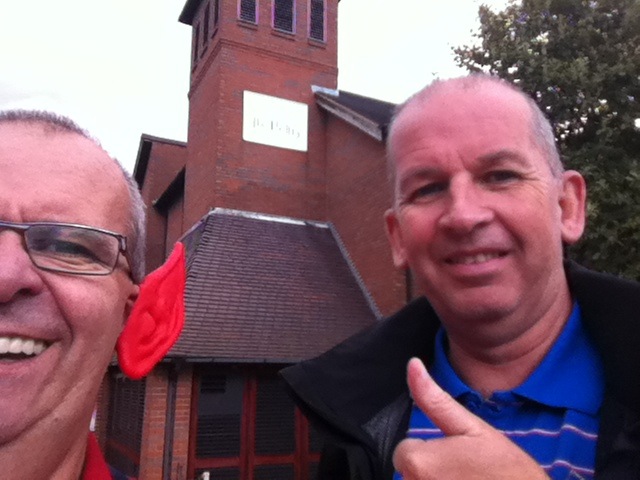
 Two Big Ears
